
Case studies
The work, by industry.
Real results from paid-search engagements across local service and e-commerce businesses. Filter by platform. Every figure shown is verified and published with the client’s permission.
Case studies
Real results from paid-search engagements across local service and e-commerce businesses. Filter by platform. Every figure shown is verified and published with the client’s permission.
We use cookies to measure ad performance and improve the site. Read our privacy policy.
Google + Microsoft
A full-funnel rebuild: service-specific landing pages, conversion tracking from scratch, and a balanced Search + Performance Max program across Google and Microsoft Ads.
The challenge
When this Chicago-based regenerative medicine clinic came on board, the foundation simply wasn’t there to support paid traffic. The website was a generic, template-style site: thin content, weak calls-to-action, and little messaging that communicated the specific services on offer. Nothing on the page gave a visitor a reason to act.
On the advertising side, both the Google Ads and Microsoft Ads accounts were running broad, beginner-style campaigns: no service-specific keywords, and none of the asset layers that drive performance in this industry (call and phone assets, image assets, sitelinks, structured snippets, callouts). There was no negative-keyword strategy, so budget leaked on irrelevant searches, and no proper conversion tracking: no CallRail, no CRM, no reliable way to know what was working.

Goals
Consistent daily lead flow
Low, stable cost per acquisition
Reliable end-to-end conversion tracking
The strategy
I designed a dedicated landing page with a clear contact form, then built individual service-specific pages for each core treatment: TRT, hormone replacement, stem cell therapy, knee pain, and ED.
Each page was structured to speak directly to the intent behind that specific service rather than lumping everything into one generic page.

With no CallRail or CRM at the outset, I built the tracking infrastructure from the tools available. Google Tag Manager fired a conversion on a dedicated thank-you-page trigger, so every form submission that landed on that URL was captured.
I layered phone-call tracking on top, then connected everything into GA4 for a clean, reliable measurement picture.

With the pages and tracking live, I built service-based search campaigns across both Google Ads and Microsoft Ads, anchored on high-intent, service-specific keywords and supported by the full asset stack the previous setup was missing.

From day one I built and continuously expanded a negative-keyword list, mining the search-term reports to filter out informational queries, unrelated conditions, and bargain-hunter terms that don’t convert in a high-ticket medical category.
That kept spend concentrated on genuine patient intent and steadily improved the quality of incoming traffic.

Rather than set-and-forget, I treated ad copy as an ongoing experiment, A/B testing responsive search ad headlines and descriptions across angles, trust signals, urgency, and benefit-led hooks for each treatment category.
Winning variations were scaled and underperformers retired on a continuous cycle.
Once search was performing, I tested Performance Max alongside it. PMax pulled in volume at a noticeably cheaper CPC; search brought highly relevant traffic at a higher cost per conversion.
The instinct is to lean into the cheaper channel, so I tested exactly that, pausing several search campaigns to let PMax run solo on a higher budget. PMax conversions dropped off sharply. The two channels weren’t competing; they were feeding each other. With search switched back on, PMax recovered and produced strong volume again, and running both in tandem became the core of the strategy.
This isn’t a set-and-forget setup. A monthly strategic call reviews performance, aligns priorities, and sets the optimization roadmap: seasonality, new service pushes, budget shifts.
Between calls the work continues: negative-keyword expansion, ad-copy testing, and budget rebalancing across Search and PMax.
The proof
Verified results
Permission-cleared figures
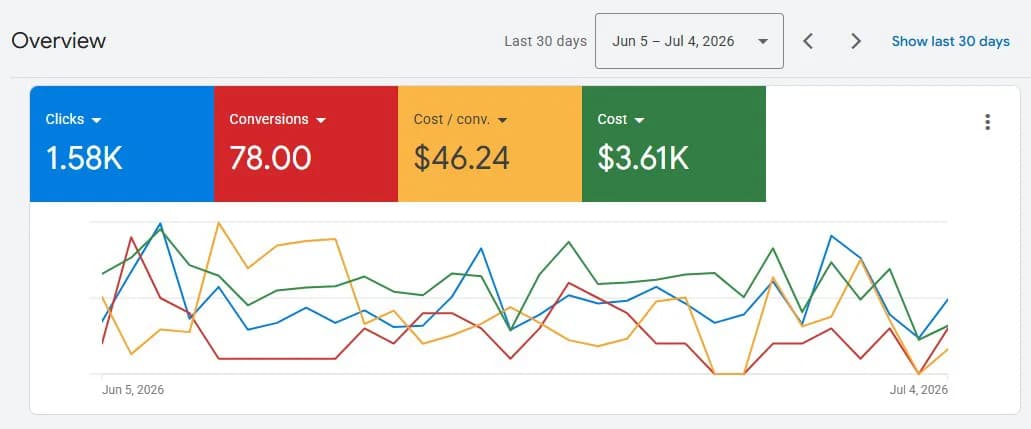
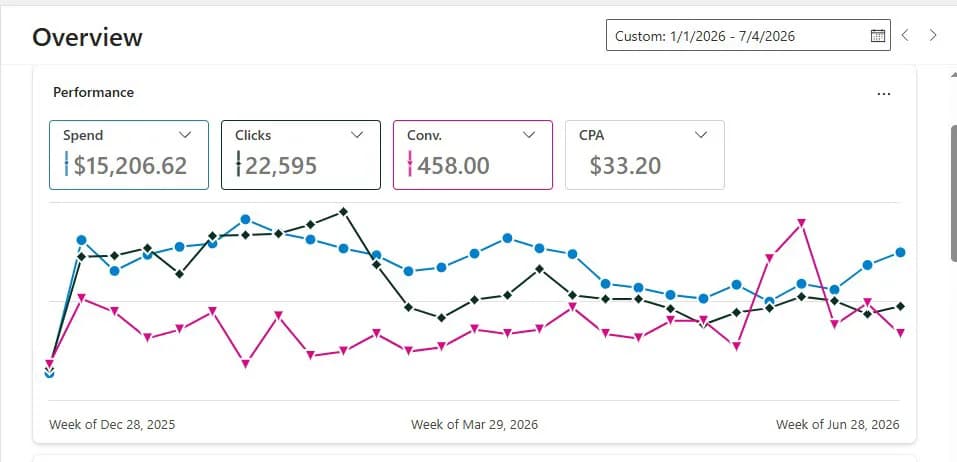
$40–$50
Cost per lead
4–5 / day
Qualified leads
2
Ad networks
Key takeaway
In regenerative medicine the winning formula isn’t a single channel. It’s a properly built funnel (dedicated landing pages, airtight conversion tracking, and disciplined negative-keyword management) feeding a balanced Search and Performance Max mix that reinforce each other, refined through continuous ad testing and a steady monthly cadence.
FAQ
Figures and creative shown are real, verified and published with the client's written permission.
More case studies
Ready when you are
Get a free, no-obligation account review from a senior specialist, the same full-funnel approach, mapped to your services. Numbers first, commitments later.